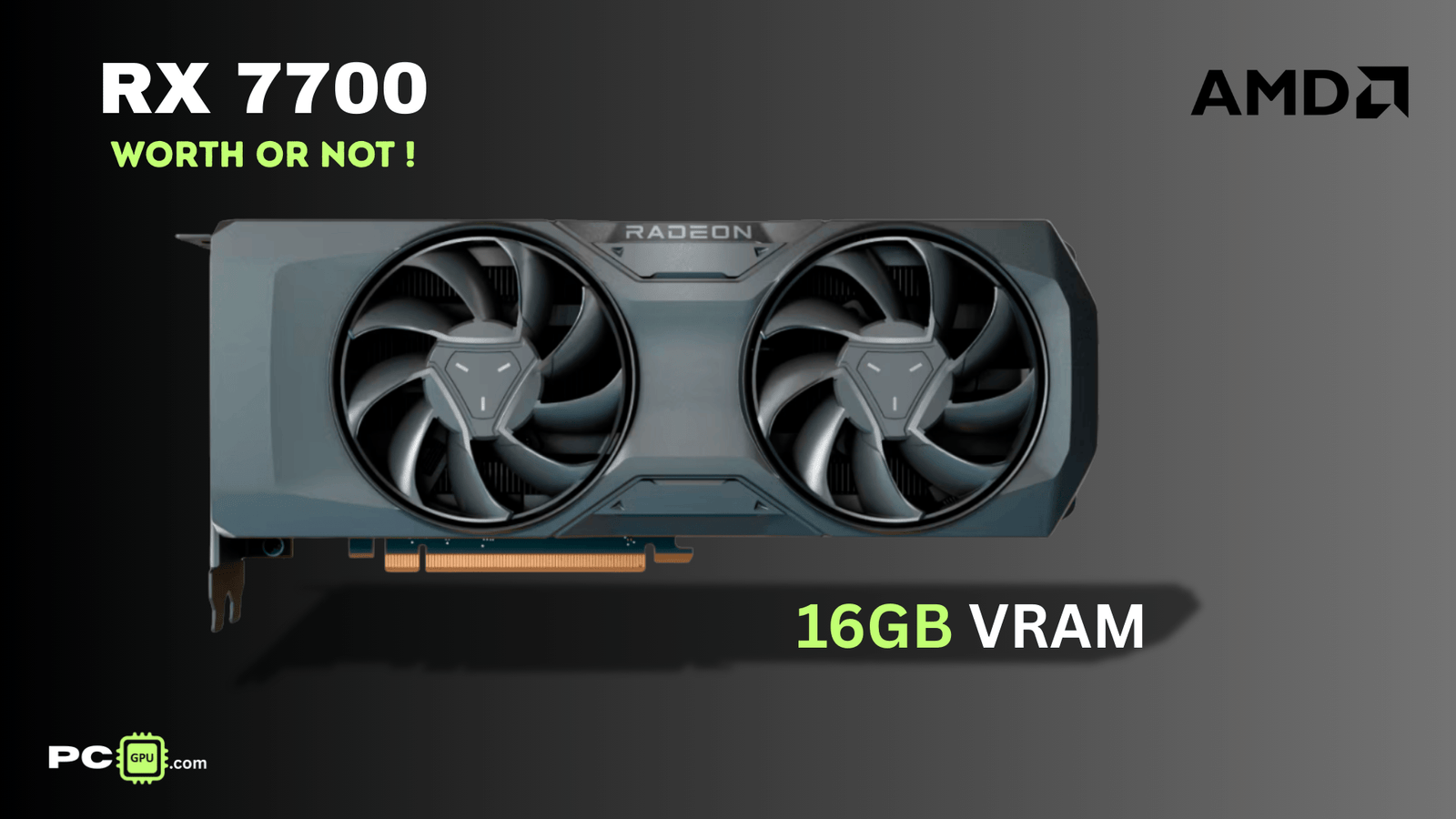

AMD has launched its new GPU Radeon RX 7700 on September 18, 2025, with a massive 16GB GDDR6 memory, so what will happen to the RX 7700 XT? Let’s see what kind of graphics performance we can expect from this GPU and whether it would be a good idea to get this GPU.
Right from the start, AMD has been offering the best price for performance in CPUs and GPUs. Even though Nvidia was ahead of AMD since the very beginning, you have to pay a bit more for Nvidia GPUs because, as you might know, Nvidia improved its technology a lot. Still, if you desire the best pure gaming performance but at a lesser cost, AMD GPUs are the choice that suits you better.
A few days ago, AMD launched the most powerful AI-ready workstation GPU to date, the R9700, and also the most power-efficient GPU, the RX 7400, which has a TDP of just 43 W, that you are seeing in prebuilt PCs.
Just as AMD recently released the RX 9060 following the Radeon RX 9060 XT, it also released the Radeon RX 7700 after the RX 7700 XT was successful, albeit with an enormous 16 GB memory. But since the RX 7700 XT already exists, did the world really need the RX 7700 GPU? Will we exclusively have this new AMD Radeon RX 7700 GPU only in OEM gaming prebuilts? AMD hasn’t made this clear yet, so let’s see.
Table of Contents
RX 7700 Cores:
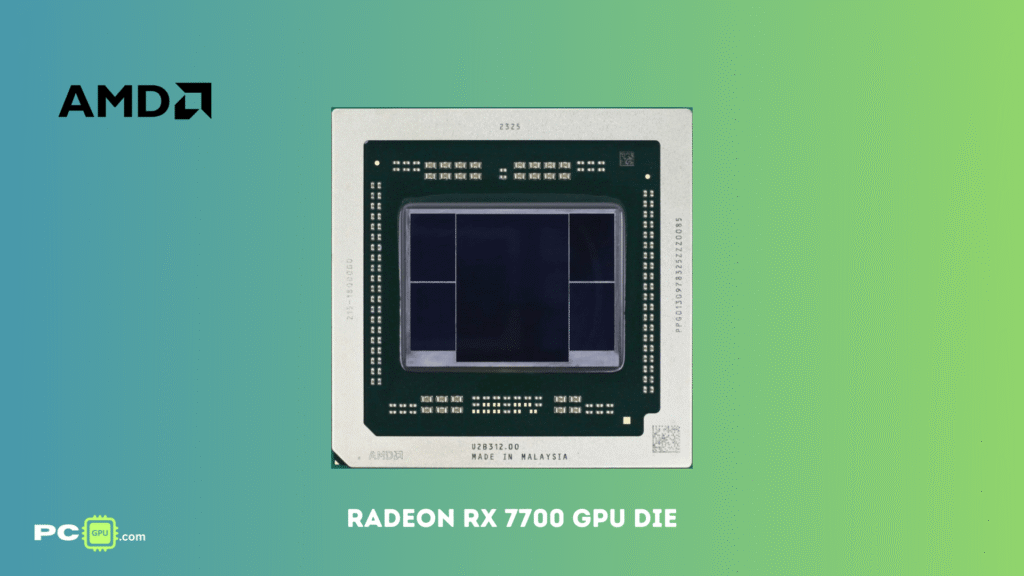
In terms of on-paper specs, the Radeon RX 7700 GPU is based on the Navi 32 architecture. The AMD Radeon RX 7700 (non-XT) has a total of 40 Compute Units, while the RX 7700 XT has a total of 54 Compute Units. If we talk about the Steam processor, you get 2560 Shader Units in the RX 7700, whereas the RX 7700 XT comes with a total of 3456 Shader Units. Looking at the Texture Units, the RX 7700 (non-XT) has 160 units, along with 80 Matrix Cores and 40 Ray Tracing Cores, while the RX 7700 XT has 216 units, 108 Matrix Cores, and 54 Ray Tracing Cores.
Now, in the GPU, AMD has played the entire game; the RX 7700 has a base clock of 1900 MHz, a game clock of 2400 MHz, and a boost clock of 2600 MHz. Meanwhile, the RX 7700 XT has a base clock of 1435 MHz, a game clock of 2171 MHz, and a boost clock of 2250 MHz.
Specs: RX 7700 vs RX 7700 XT:
| Specification | Radeon RX 7700 (non-XT) | Radeon RX 7700 XT |
|---|---|---|
| GPU Architecture | RDNA 3 (Navi 32) | RDNA 3 (Navi 32) |
| Compute Units (CUs) | 40 | 54 |
| Stream Processors (Shaders) | 2,560 | 3,456 |
| VRAM | 16 GB GDDR6 | 12 GB GDDR6 |
| Memory Interface/Bus Width | 256-bit | 192-bit |
| Memory Bandwidth | ~624 GB/s | ~432 GB/s |
| Infinity Cache | 40 MB | 48 MB |
| Typical Board Power (TBP / Power Draw) | ~263 W | ~245 W |
| Ray Accelerators | 40 (2nd Gen) | 54 (2nd Gen) |
RX 7700 Memory:
Now, when it comes to video memory, the performance of any GPU is dependent on its VRAM. The RX 7700 (non-XT) comes with 16 GB of GDDR6 VRAM with a 256-bit interface, and its memory clock is 2430 MHz, which provides an effective speed of 19.4 Gbps, totaling a bandwidth of 622.1 GB/s. On the other hand, the RX 7700 XT has 12 GB of GDDR6 VRAM with the same 192-bit interface; its memory clock is 2250 MHz, which gives an effective speed of 18 Gbps, resulting in a total bandwidth of 432 GB/s. The performance of any CPU or GPU also depends on Level 3 Cache memory; the RX 7700 has 40 MB of AMD Infinity Cache, while the RX 7700 XT has 48 MB of Level 3 Cache, which is why the RX 7700 performs better. Both of these GPUs are designed for 1080p and 1440p gaming and streaming; however, it will be interesting to see which of the two GPUs offers a better price-to-performance ratio.
RX 7700 Power Draw:
The AMD Radeon RX 7700 (non-XT) consumes approximately 263W at peak with 16GB, while the AMD Radeon RX 7700 XT consumes about 245W at peak with 12GB. AMD has recommended a 700W power supply for both of these GPUs. On the other hand, the Nvidia RTX 5060 8GB offers 3-4% better performance than the Radeon RX 7700 with a TDP of only 145W, and that too at a price point of just $299 USD.
RX 7700 Benchmarking:
| Spec/Feature | Detail |
|---|---|
| GPU | AMD Radeon™ RX 7700 |
| Target Gaming | Designed for immersive gaming & streaming experiences at 1440p |
| Average FPS at 1440p (Ultra Settings) in various Titles* | • Call of Duty: Black Ops 6—~71 fps • Resident Evil 4 (RT High) — ~70 fps • Dying Light 2 (RT) — ~63 fps • Red Dead Redemption 2—~68 fps • Hogwarts Legacy—~64 fps • Grand Theft Auto V Enhanced (Max RT) — ~66 fps • Marvel’s Spider-Man 2—~66 fps • Ghost of Tsushima—~66 fps |
| Test Gaming PC Configuration | CPU: Ryzen 7 9800X3D Memory: 32 GB DDR5-6000 Motherboard: X870E OS: Windows 11 Pro Driver Version: 25.6.2 |
RX 7700 Price:
Speaking of price, the AMD Radeon RX 7700 XT was launched on August 25, 2023, with an MSRP of 449 USD and is now available on Amazon.com for 339 USD for the XFX Speedster Dual Fan RX 7700 XT 12GB GDDR6, while the Asus Dual RTX 5060 8GB GDDR7 is available for 299 USD and could be available for even less on offer. However, if AMD has launched this Radeon RX 7700 GPU solely for prebuilt gaming PCs of OEM partners, then you won’t need to worry about the price. So let’s see what update we get from AMD.